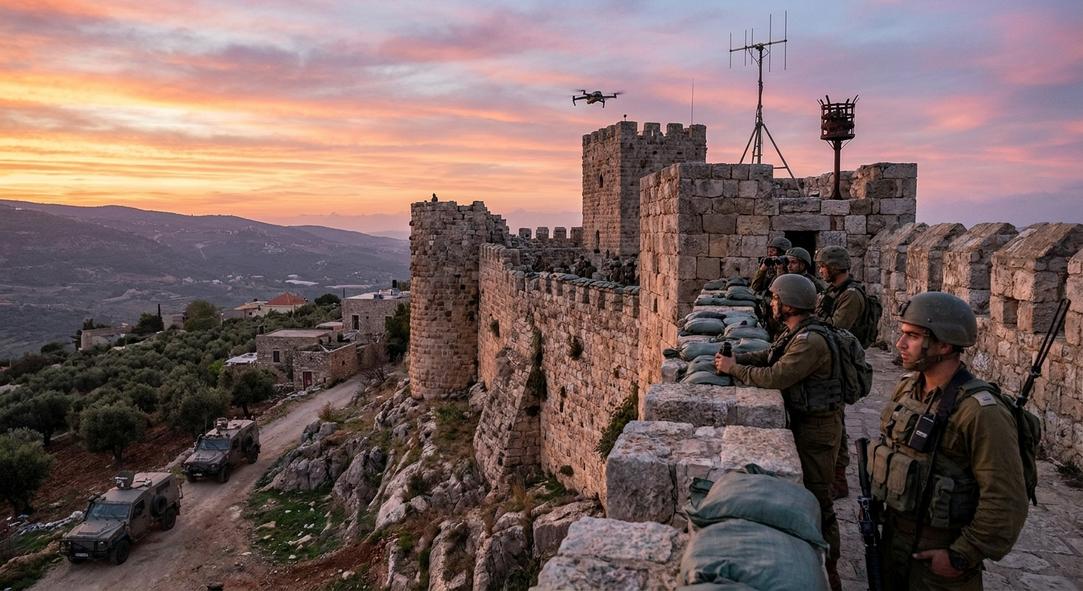
Israel Seizes Castle in Lebanon: A Modern Tale of Medieval Proportions 🏰🗺️
In the annals of military history, when modern armies clash, it is seldom that the battlefield scenes resemble those out of a medieval chronicle. Yet, here we are. With Israel’s recent action to seize control of a medieval castle in Lebanon, what seems like a vestige of a bygone era reemerges as a pawn in a new-age geopolitical chessboard. Might it be history’s own joke that a 21st-century superpower would covet a fortress designed for knights and archers? 🤔
The Irony of Historical Echoes
From the shadows of French knights who fortressed themselves against invading forces long ago, this castle now stands — a silent yet resonant witness to another type of defense, or perhaps, an offense. Israel, in this modern epic, pursues its campaign in South Lebanon with strategic precision, leveraging a structure built in the age of chivalry. Isn’t it grand how history, with its sublime sense of irony, sometimes entwines its vines across centuries? 🌿🛡️
According to military analysts, the castle’s strategic vantage point could help Israel maintain a fortified position against hostile incursions. In the face of accelerating tensions in the Middle East, such a stronghold might offer the high ground—both physically and symbolically—amid the uncertainties besieging regional geopolitics. But the real question remains: amidst cutting-edge military technology, what does the reliance on ancient architecture say about the inheritance of conflict and power? 📈🏰
Antithesis of Eras: Past and Present
While once ironclad armor was the epitome of battle readiness, today it’s about unmanned drones, cyber rigs, and Iron Dome systems that sway the balance in the region. This juxtaposition starkly contrasts the erstwhile and the now, posing an intriguing question: can old stones bear new burdens? As architecture meant for crossbows stands against digital age weaponry, one can’t help but wonder about the paradoxes history weaves. ⏳⚔️
- Technological Advancement: Today’s battles are waged through satellites and digital landscapes, yet here we see a reliance on a fortress from centuries past.
- Symbolic Power: Control of a castle is a potent emblem of eternal power dynamics, reminiscent of past kingdoms and current states in flux.
- Geopolitical Stakes: The interplay between historical relics and modern needs reflects both continuity and change across the timelines of conflict. 🔄
A Metaphor of Endurance and Adaptability
As we dissect these unfolding scenarios, the analogy of a fortress, enduring against the ravages of time, finds its place. Like the slow weathering of ancient stonework, this conflict etches its marks on human consciousness, undisturbed by the march of eras. The castle, much like the region’s struggles, has proved resilient, resisting the erode of centuries—a testament to persistence in the face of relentless change. 🌍🏰
In this age of digital nimbuses, where the old collides with the new, we find ourselves spectators to a peculiar symbiosis. For the onlookers, weary of the shifting sands of Middle Eastern politics, this castle stands not just as a relic but as a poignant reminder of the past’s persistent whisper in today’s noisy agora of global diplomacy. Is this not, ultimately, a nod from history, suggesting that while times may change, the heart of human conflict remains carved in stone?
As new chapters write themselves onto the lands around the Mediterranean, scholars and soldiers alike ponder the lessons etched into the walls of ancient bastions. One wonders what tales of human endurance and folly will continue to be fortified in the structures left standing. Will the castles of today serve as the backdrops to tomorrow’s stories, or rather, relics in a land where history is both a haunting and a guide? The answer may yet lie waiting within their walls. 🏰✍️🔍